
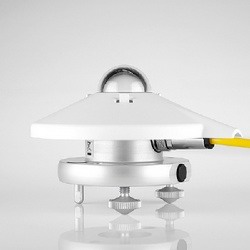
-Working principle:
The total solar radiation meter transfers radiation energy to its black receiver surface and converts it into thermal energy through absorption. The special black coating has an absorption coefficient close to 1 throughout the entire spectral range. This thermal energy causes a measurable increase in temperature. The surface of the receiver with blackened thermoelectric sensors usually meets the standard orientation requirements for spectra and spectra. The temperature rise is usually determined by measuring the difference between the surface temperature of the receiver and the temperature of the radiator, such as the housing sensor of a contactor.
Our SMP series solar total radiation meters are based on the proven CMP series technology, equipped with microprocessors, memory, and firmware, making the product more intelligent and responsive.
The Modbus interface is directly connected to RTUs, PLCs, SCADA systems, industrial networks, and controllers. Through intelligent addressing, 247 instruments can be connected in a single measurement network. The measurement data is updated around every second, and users can access irradiance, type, serial number, instrument settings, complete calibration history, status information, and various other data. Digital signals avoid various problems that may arise from common analog-to-digital conversion with industrial data recorders and input modules, ensuring the analog-to-digital conversion of the 24 bit differential input of the solar total radiation meter. The SMP series solar total radiation meter can operate within the range of 5-30 VDC power supply, and the power input is equipped with electrode reverse connection and overvoltage protection. The SMP series products adopt a feedforward algorithm, which has a faster response speed than the analog CMP series, and integrates temperature sensors and polynomial function algorithms to better correct temperature.
Applied to meteorological and climate networks around the world
Provide reliable measurement results for the site selection and production capacity prediction of solar power plants